 | en - es - fr April 2021    |
|
|
| |||||
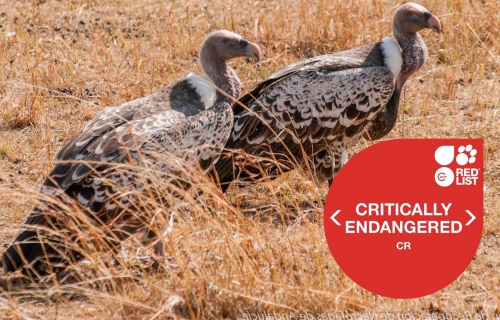
Conservation managers, vulture experts and researchers from Europa and Africa analysed the displacement of this Critically Endangered scavenger, whose populations are increasingly exceeding their natural range in the Sahel and appearing in North Africa, Spain and other parts of Africa and Europe. The First international symposium on the Rüppell’s vulture in the Mediterranean region (24th March 2021, online) was organised by IUCN-Med and the regional Government of Andalusia, with the support of the MAVA Foundation. Why species displacement creates new conservation challengesHuman-induced mortality drivers such as direct persecution and poaching, as well as habitat loss, food scarcity and droughts have strongly increased the pressure on the populations of Rüppell's vultures in southern Africa, leading to an estimated 97% decline during the last 30 years. Poisoning or electrocution and collision with energy infrastructure could also be major threats for the species. In the last 15 years, Rüppell's vultures have increasingly been recorded outside their historic breeding areas, both south and north of the Sahel, reaching the Iberian Peninsula through the Strait of Gibraltar. As a result, the species has become a regular visitor travelling with the griffon vultures returning to Spain from Sahel wintering areas. Non-breeding populations are regularly observed in Morocco, whereas breeding observations within griffon vulture colonies have been recorded in Algeria. This expansion could mean the beginning of a colonisation process towards more suitable habitats and a response to climate change and other mortality factors. As a result, the Mediterranean could represent a key refuge area for the species. Enhancing cooperation to fill knowledge gaps and mobilise actionThe main objectives of the First international symposium on the Rüppell’s vulture in the Mediterranean region were to compile and unify existing information on the status of the species in this region; to assess the role that the region could play for the conservation of this vulture; to establish common management and conservation lines and to create links among relevant African and International institutions. The will to mobilise joint efforts was supported by the participating experts and organisations, , including the Vulture Conservation Programme of the Andalusian regional Government, the IUCN Species Survival Commission-Vulture Specialist Group, GREPOM/BirdLife Maroc, Mouvement Écologique Algérien and the Vulture Conservation Foundation. The symposium is a first step to assess and to define the future of the species in the Mediterranean and the role that the region is playing and can potentially play for the conservation of the species. The Rüppell's vulture is a species to be taken into account from now on in the Mediterranean according to the data provided during this symposium by the different experts. The movements towards the North seem to be linked to the disturbance of the species in the southern Sahel, where the situation is critical for the species, but the real causes of these changes, as well as much of the information on population dynamics, breeding or mortality factors remain unknown. As it has been pointed out throughout the interventions, efforts must be made to fill in these gaps, but this should not be an impediment to taking action now. The critical status of the species requires so. More info: helena.clavero@iucn.org |
|
| Subscribe to our bulletin | To unsubscribe from our bulletin Receive the lastest IUCN World Conservation Congress updates, subscribe here. Copyright® 1995-2020 International Union for Conservation of Nature and Natural Resources. All rights reserved. |