


| El soporte central a las actividades de la UICN en el Centro de Cooperación del Mediterráneo está proporcionado por la Junta de Andalucía, y el Ministerio de Medio Ambiente, España. |
 |
 |

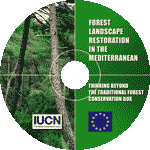 |
| This CD-rom can be found too at: http://iucn.org/places/medoffice/CDForest/index.html |
Building on the initiative of the IUCN Forest Conservation Programme, The IUCN Centre for Mediterranean Cooperation organised an expert workshop on FLR during the second week of May 2003 in Castellabate, Italy. The objective of this workshop was to identify the efforts that are taking place at the international level, and explore ways to promote FLR in the region.
The workshop established a network of experts at the regional level, as well as gathered diverse examples of Forest Landscape Restoration initiatives. This has set the information platform for developing a regional approach relevant to this issue, document success and failure stories, share examples and experiences, and promote this concept through the region.
This initiative created partnerships among three major actors in forest conservation in the Mediterranean, and these are IUCN, WWF and the International Association for Mediterranean Forests. It also highlighted how FLR can become one of the key areas for synergies among multilateral environmental agreements, as well as defined the role of the different stakeholders in restoration of degraded forests.
Beyond that event, the IUCN Centre for Mediterranean Cooperation has been communicating the significance of this holistic approach to forest conservation, and especially its importance in re-establishing ecological integrity and enhancing human well-being in deforested or degraded forest landscapes. All the case studies and technical papers related to this initiative were compiled and widely disseminated at the regional level, which has generated a great deal of knowledge on FLR. This can be found at: http://iucn.org/places/medoffice/CDForest/index.html
From the feedback received, whether directly to the Centre or through events where the Centre has disseminated this initiative, it has proven that this theme is highly promising in the Mediterranean context as it:
- Concerns the restoration of functionality of landscapes and respects their dynamic nature, as well as their complexity;
- Considers landscapes in a broader level, including biological and social values and parameters;
- Acts in a complementary way for the protection and enhancement of ecosystem integrity, especially of degraded forests;
- Involves stakeholders and encourages participation - secures long-term existence of the benefits for the society;
- Is the most appropriate tool against desertification, due to its holistic approach and the integration of social, economic and ecological parameters in planning procedures.
The Centre is part of the Steering Committee of Silva Mediterranea, and this network ensures broader dissemination of the concept in several countries in the region.
PROTECTING MEDITERRANEAN SHARKS
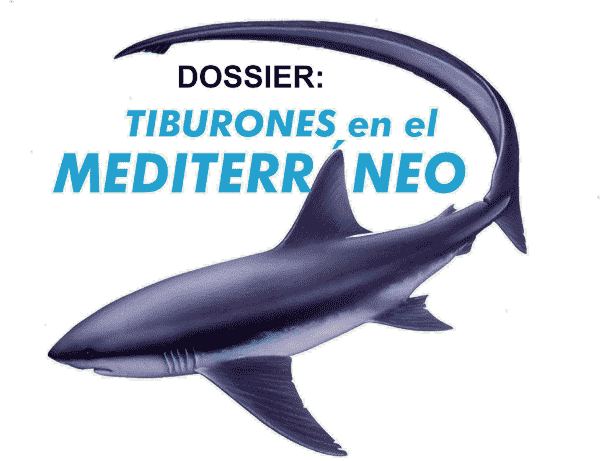 |
The IUCN Centre for Mediterranean Cooperation had gathered thirty shark experts and members of the Shark Specialist Group from eight Mediterranean countries in order to assess the status of the species in the Mediterranean. Discussions tackled opportunities for shark management and conservation in the Mediterranean Sea and the identification of priority actions for the conservation of this vulnerable group of fishes. The shark experts assessed the threatened status of the 86 species of sharks and rays that occur in the Mediterranean Sea, by applying the internationally recognised IUCN Red List criteria. The results of this assessment were submitted for discussion to other members of the Shark Specialist Group to reach consensus on the status of the species. The final assessment would enable species of particular conservation concern to be identified and targeted for conservation action.
Moreover, and to bring this initiative to the policy level, and within the context of the Barcelona Convention, the Centre has participated actively in the elaboration of the Action Plan for the conservation of cartilaginous fishes within the framework of the SPA Protocol.
At the level of communication and education, the IUCN Centre for Mediterranean Cooperation has launched a web-based media kit for journalists, educators and all those interested in sharks and marine conservation issues. It aims at raising awareness on sharks as vulnerable animals and on their populations that are in decline worldwide. The on-line media kit contains information on shark biology and environment, threats, conservation status, legislation and other general data. It has a special focus on the Mediterranean and the species occurring in this sea. The kit also includes links to other shark-related sites, documents and conservation programmes all over the world. This kit will be available soon in all the three IUCN languages to guarantee wider dissemination.
TURNING SCIENCE INTO POLICY: DEFINING IMPORTANT PLANT AREAS IN THE MEDITERRANEAN
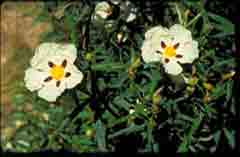 |
| Jara pringosa (Cistus Ladanifer) . Credit: CEMACAM – O. A. PARQUES AUTONOMOS. Antonio Moreno Rodríguez. |
The IUCN Centre for Mediterranean Cooperation and Plantlife International are working in partnership with the IUCN Species Survival Commission and Planta Europa to develop the Important Plant Areas (IPA) programme in the Mediterranean region. IPAs are intended to be areas of great botanical importance for threatened species, habitats and plant diversity in general, that can be identified, protected and managed as sites. The WWF/IUCN Centres of Plant Diversity project (1994) identified large regions of botanical importance, and the Mediterranean was among one of the major hotspots. This IPA programme is intended to build on this approach to identify areas that are appropriate for a site-based approach to conservation.
The first step towards pursuing this initiative in the Mediterranean
was the gathering of around 35 plant specialists from the region
who presented and discussed current conservation initiatives in
their countries: legislative, national strategies, in situ and ex
situ initiatives and special country specific needs. The experts
also developed proposals for the identification of Important Plant
Areas (IPA’s) in the region, and for moving the IPA programme
in Mediterranean countries forward.
Responding to International policy processes, IPA identification
provides the framework for governments to achieve Target 5 in the
Convention on Biological Diversity’s Global Strategy for Plant
Conservation. IPA identification is also a tool intended to add
to conservation efforts by providing specific plant data (Redlists)
that can inform other existing national, regional and global conservation
programmes. It will also make available a foundation of mapped data
regarding IPA’s, set standards and act as a reference point
linking science and policy, thus guiding relevant national legislation
and providing a structured approach for future environmental impact
assessments, compensation measures and further decision-making processes.
The Centre if following up on the initiative through building partnerships
and drawing up specific funding proposals that will support the
implementation of this initiative in several countries in the region.
The Centre will also support a series of scientific studies in four
countries to help them prepare the grounds for the identification
of Important Plant Areas.
Figure 1. The Mediterranean and other regions in the wold
| Region |
Surface
km2 |
Nº
plant species |
Nº
endemic species |
%
endemic species |
Mediterranean |
2.300.000 |
25.000 |
12.500 |
50 % |
Zaire |
2.345.000 |
11.000 |
2.800 (aprox.) |
30 % |
India |
3.166.000 |
15.000 |
5.000 |
30 % |
Australia |
7.682.000 |
22.000 |
7.600 |
34 % |
WORLD PARKS CONGRESS: BACK TO THE REGION WITH A BROADER VISION
The Mediterranean region has over 2,200 protected areas scattered through the 21 riparian countries, and the richness of this regional experience was analysed in Murcia where a Mediterranean Protected Areas meeting was organised by the IUCN Centre for Mediterranean Cooperation. This event represented a common will to develop partnerships at the Mediterranean level and was a major step towards defining a Mediterranean vision for the management of protected areas. 120 representatives from 22 Mediterranean countries participated in the event and developed common orientations related to 5 different Durban workshop streams. These orientations were later fed into the Durban process to guarantee that the Mediterranean ‘voice’ is heard in International fora.
 |
| This CD-rom can be found at: http://iucn.org/places/medoffice/cdmurcia/ |
This process was later followed up by an activity to build the capacity of protected area managers in the region, where IUCN Centre for Mediterranean Cooperation organised, with the support of the Spanish Agency for International Cooperation, an advanced seminar on management of protected areas. This seminar gathered managers, experts and personnel working in protected areas from Morocco, Algeria, Egypt, Tunisia, Jordan, Lebanon, Bosnia and Herzegovina, Serbia and Montenegro and Albania, where the Durban Action Plan was exposed, and experts exchanged views on how to promote its implementation at the national level, as well as means for improving governance processes that would support building an efficient Mediterranean Protected Areas network. This will also be pursued through the meeting that the Centre is planning to hold this coming year, gathering directors of nature conservation in the region, in an effort to mainstream the outcome of the World Parks Congress in national policy planning. Moreover, The Centre is promoting co-operation in conjunction with regional authorities who are responsible for management of protected areas, and reinforcing regional initiatives and partnerships that are relevant to management of reserves and natural areas in the Mediterranean.